Saturday, November 28, 2009

How Adam Got Eve

How Adam Got Eve


Nothing like a good Bible story to make your day.


How Adam Got Eve -- Priceless

Adam was hanging around the garden of Eden feeling very lonely..


So, God asked him, 'What's wrong with you?'


Adam said he didn't have anyone to talk to.

God said that He was going to make Adam a companion


and that it would be a woman.


He said, 'This pretty lady will gather food for you, she will cook for you,


and when you discover clothing, she will wash them for you


She will always agree with every decision you make and she will not nag you,


and will always be the first to admit she was wrong when you've had a disagreement.


She will praise you!


She will bear your children.


and never ask you to get up in the middle of the night to take care of them.


'She will NEVER have a headache and will freely give you love and


passion whenever you need it.'


Adam asked God, 'What will a woman like this cost?'

'An arm and a leg..'


Then Adam asked, 'What can I get for a
rib

Maxine on the Bailout!

Maxine on the Bailout!


BAIL 'EM OUT ????

Heck, back in 1990, the Government seized the Mustang Ranch brothel in Nevada for tax evasion and, as required by law, tried to run it.
They failed and it closed. Now we are trusting the entire economy of our country, our banking system, our auto industry, and possibly our health plans to the same nit-wits who couldn't make money running a whore house and selling whiskey!"

Friday, November 27, 2009

Picture worth a billion words (minimum)

This Picture is Worth

1000 Million Words (minimum!) . .

We truly take a lot for granted. Forget the football 'heroes' and movie 'stars'. Pass this on so that all may know the price of freedom

Only two defining forces have ever offered to die for you,

Jesus Christ and a Soldier

One died for your soul; the other for your freedom.

Anyway

People are often unreasonable, illogical, and self-centered;
… Forgive them anyway.
If you are kind, people may accuse you of selfish, ulterior motives;
… Be kind anyway.
If you are successful, you will win some false friends and some true enemies;
… Succeed anyway.
If you are honest and frank, people may cheat you;
… Be honest and frank anyway.
What you spend years building, someone could destroy overnight;
… Build anyway.
If you find serenity and happiness, they may be jealous;
… Be happy anyway.
The good you do today, people will often forget tomorrow;
… Do good anyway.
Give the world the best you have, and it may never be enough;
… Give the world the best you’ve got anyway.
You see, in the final analysis, it is between you and God;
It was never between you and them anyway.”
——— Mother Theresa.

Thursday, November 26, 2009

National Budget on Defense VS HHS plus SS

The graph on the right is of the percentage of the National Budget spent on Department of Defense both Civilian and Military plus the VA compared to spending on Health and Human services plus Social Security. Since 1962 they have completely switched places from defense taking over half the budget to social services taking over half of it. In 1962 the defense portion was 52.1 % compared to 16.7% for the social services. In 2007 it was defense 22.1% to social services 45.4. According to the 2009 budget, the estimate for 2013 is defense 19.2% and social services 50.3%. Think about that next time someone complains about the defense budget taking from social programs. Or they want to create a tax for funding defense. The progressives want to eliminate defense and they are well on their way. This comparison is even more extreme when you consider that the dollars involved have gone from about 100 billion in 1962 for the entire national budget to 3.5 trillion now. That is an increase of the total budget of three thousand five hundred percent. Thus if the percentage allocations had remained the same they would have been spending 35 times more than in 62. For a look at the actual dollars involved in 1962 the combined spending of defense and VA was 56.675 billion and for 2007 which is the last year we have actual numbers it was 649.808 billion an increase of 11.46 times or 1146 percent. For the combination of Health and Human Services and Social Security in 1962 they spent 17.9 billion as compared to 1,233.8 billion which is 1.2338 trillion for an increase of 68.9 times, 6,890 percent. The 2013 estimate is defense 707.914 billion compared to HHS and SS of 1,798.606 billion or about 1.8 trillion. Guess we can see where all the increased spending has occurred and continues to do so. Sure not on military. But now we want a tax just for the military spending so we can make people more aware of the military spending while we ignore the big spending abuse of social welfare programs.

Wednesday, November 25, 2009

Net Neutrality Basics

It seems this relates more to the government telling one business what they have to provide in order to subsidize another business. Nice idea for those who want someone else to pay for what they get for free, but seems to have severe ramifications on internet service providers with the increasing bandwidth requirements we are all using. Thus it seems to be anti free market capitalist which takes us back to why our current administration is pushing it. Sounds good on the surface, we should all get the same products and services regardless of price we pay or our ability to pay. Kind of sounds like many other administration policies. One thing about it, they are consistent in pushing socialist ideas on all fronts.


Who’s ‘right’ in the Net Neutrality debate?
  • 16 Comments
  • Share
by Nicholas Deleon on September 26, 2009

angels

This past week saw the resurrection of Net Neutrality as a divisive issue. Some folks (people like Google, and, well, us) are in favor of Net Neutrality, while other folks (primarily the ISPs) are against it. Not long after the FCC announced its intentions, six Republican senators, three of which who received quite a lot of money from AT&T, proposed an amendment to a bill to stop the FCC in its tracks. The senators later rescinded their amendment, saying that they were now open to a “dialogue” with the FCC.

Which brings up to today’s point: are there any angels in this debate? The Wall Street Journal recently, I guess, came to the defense of the ISPs: why should Google and whoever else be allowed to profit off the Internet Service Providers’ networks? Why should, say, Time Warner, subsidize Google’s online applications with its broadband network when it (Time Warner) doesn’t stand to make any money?

That’s how the Wall Street Journal characterizes it, at least.

The WSJ says that people like Google (I keep bringing up Google because it stands to benefit the most from an open Internet) want to maintain the status quo: it doesn’t want to have to pay Time Warner (or whoever) hand over fist just to keep it from shutting off access to Google Maps.

The WSJ also brings up how one of Google’s top lobbyists, Andrew McLaughlin, recently got a job in the Obama Administration as deputy head of telecom policy. The scary implication, of course, is that now Google will get whatever the hell it wants because one of its former guys is now in a proper policy-making position. If only things were that easy.

So, basically, I’ve just said nothing other than that this Net Neutrality business can get really complicated if you want to devote the time to it. I stand to benefit more from a Net Neutral world, so I’m in favor of that, which is only logical. You’re free to disagree, of course. In fact, I encourage it! More opinions expressed = a better chance of coming to a well-informed conclusion.


The Net Neutrality Debate All On One Page
by Erick Schonfeld on August 31, 2008

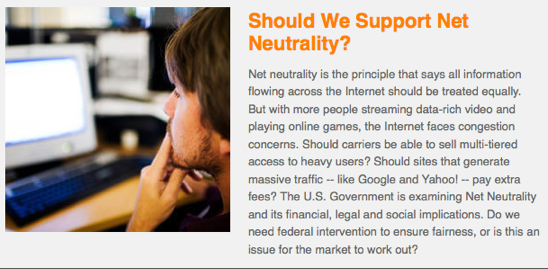
Are you confused about Net Neutrality? Who isn’t? Some people argue it is necessary for continued innovation on the Internet, and point to Comcast’s bandwidth metering as a sign of things to come. Others claim that it is unnecessary regulation that will create unintended consequences in its wake. Opposing Views, the debate site that pits experts against each other to argue the pros and cons of the big questions of the day (read our launch review), last night put up a page on Net Neutrality. The page lays out the arguments pro and con for Net Neutrality, and then links to fuller arguments.

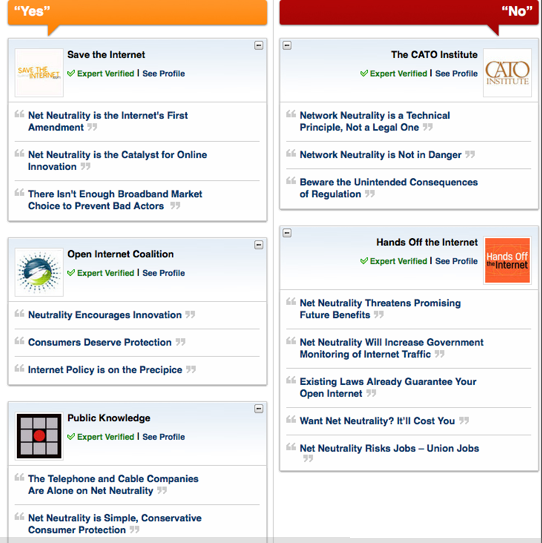
Marshaling the arguments for Net Neutrality are the Save The Internet Coalition, the Open Internet Coalition, and Public Knowledge. (It’s a freedom of speech issue, the ISPs are quasi-monopolies that cannot be trusted, innovation on the Web is at stake). Arguing against are the Cato Institute and Hands Off The Internet (it’s a technical issue best left to engineers, the cost of Net Neutrality will be passed onto consumers, regulation will backfire). Readers are then encouraged to vote on who is winning the argument, an add their own points of view, which can be elevated to the main discussion page.

Here’s a sample of some of the back-and-forth. The Open Internet Coalition argues that it is a fundamental principle:

Too often, the discussion of why we need to protect the open Internet degenerates into a stale debate about regulation versus the free market. In fact, it’s impossible for innovation to continue apace without some basic rules of the road to protect that innovation.

The open Internet was the principle leading the development of the Internet as the first open global communications network. And it helped drive the development of a host of Internet applications like Facebook, YouTube, and Skype. There would have been no motivation for the developers of these applications to have expended time, effort, and in some cases, their own financial security, in pursuit of their vision if they weren’t guaranteed their inventions would have been able to work over any Internet connection.

The Cato Institute warns of the difficulty of enforcing fuzzy concepts:

it’s important to remember that network neutrality is fundamentally a technical principle. Like any technical principle, it is fuzzy at the edges.

. . . Leading network neutrality proposals contain numerous ambiguities that would create uncertainty for everyone in the Internet industry. Here’s just one example: the most prominent network neutrality proposal of the 2006 congressional session, known as Snowe-Dorgan, defined a “broadband service provider” as “a person or entity that controls, operates, or resells and controls any facility used to provide broadband service to the public, whether provided for a fee or for free.” Does this mean that the owner of a coffee shop with a WiFi connection would be subject to FCC regulation of its firewall configuration? One would hope not, but that’s what the language seems to suggest. The same point can be made with respect to hotels, Internet cafes, airports, and even individuals who choose to make their home WiFi connection available to their neighbors.

Where do you stand on Net Neutrality? Go debate.

HSI e-Alert - You've Got to Ask...

Dear Reader,

Every now and then, when a study comes along that just doesn't add up, I find myself wondering: What the heck was in that placebo?

In placebo controlled clinical trials that the medical mainstreamers are always holding up as their sacred "gold standard," the placebo pill is assumed to be inert. In fact, it's a blind spot.

In trials financed by drug companies, the company supplies the placebo and controls the ingredients. The FDA does not oversee placebo ingredients. No one does.

So for instance, if a drug prompts a side effect, such as howling at the full moon, drug company execs might be tempted to include something in the placebo that would also prompt full moon howling. That way, the published write up of their study would simply note that side effects were similar in both groups.

That's just one way a placebo with a little something extra might tweak study results.

Which brings us to a new trial that tested Chantix, a best selling smoking cessation drug. I'm not saying there were any disreputable hijinks involved with this research. But some of the details had me wondering: What the heck was in the placebo?

-----------------------------------------------------------
Powerful stuff
-----------------------------------------------------------

UCLA researchers put Chantix up to a very difficult test: COPD.

According to Dr. Donald Tashkin, the leader of the UCLA study, Chantix came through like a champ!

This is impressive because Dr. Tashkin tells Reuters Health that cigarette smokers with COPD (a debilitating and steady deterioration of the respiratory system) actually find it harder to quit smoking than smokers who have avoided the disease.

The UCLA team recruited about 500 smokers with COPD. On average, subjects were in their late 50s and had been smoking for about 40 years. For 12 weeks, half the group received Chantix while the other half received a placebo.

Results: One year after the beginning of the study, nearly 19 percent of the Chantix group had successfully refrained from smoking, while nearly six percent of the placebo group had quit.

Considering how hard it is for COPD patients to quit smoking, I suppose that one success story out of every five attempts might be considered an impressive result.

But what's really surprising is that ANYONE in the placebo group was successful. I mean, you have a disease that makes it harder to quit, but still, you successfully kick the habit after FOUR DECADES of steady smoking.

Hmmm. That's an unusually powerful placebo effect!

-----------------------------------------------------------
Bad ideas
-----------------------------------------------------------

Here's where the study gets very fishy: side effects.

You may remember Chantix dangers from several previous e- Alerts. For instance, in the first quarter of 2008, the number of serious reactions reported to the FDA was higher with Chantix than with all of the 10 best selling brand name drugs COMBINED.

One year later, the FDA required Pfizer, the maker of Chantix, to include a Black Box Warning that the drug might prompt depression, suicidal ideation, and suicidal actions.

In the UCLA study, Chantix side effects included nausea, insomnia, and abnormal dreams. But serious side effects were MORE common in the placebo group. And no one in the Chantix group reported suicidal ideation, but one person in the placebo group did.

Wow. That is an astounding placebo effect!

But wait -- before we ask the question -- I have two more details: 1) The trial was funded by Pfizer, and 2) Dr. Tashkin is a consultant for Pfizer.

Okay? All together now: What the HECK was in that placebo?


...and another thing


I don't believe there's enough champagne in France to accommodate all the celebrating that must be going on at drug companies these days.

Well, not ALL drug companies. Just the five that have a sweet piece of the H1N1 vaccine action.

So far, the U.S. has ordered 195 million doses of the vaccine. But don't be surprised when that number goes higher. A few days ago, the FDA approved the use of Australia's CSL Limited H1N1 vaccine in children 6 months and older. Previously, the approval was only for teens and adults, 18 years and older.

And an added bonus: The approval includes CSL's seasonal flu vaccine. So just imagine the delirious joy this news must have brought the vaccinators at CSL.

The vaccine is available in two forms: 1) A single dose that's preservative-free, or 2) a double dose that contains thimerosal, the mercury-based preservative.

Hmmm. Now, why in the world would they make one form with a double dose of mercury, and another single-dose form with zero mercury?

Could it be because many parents who (wisely) suspect the shot is unnecessary would quickly opt out if their only choice included thimerosal?

Television medical pundits are quick to dismiss any link between thimerosal and autism. They call it "junk science" and no one ever questions them. But the mercury is still there. And mercury is still a neurotoxin. And many parents (wisely) ignore the assurance that it's perfectly safe to inject this heavy metal into ANYONE -- particularly infants.

To Your Good Health,

Jenny Thompson


Is the secret to "eternal youth" locked inside a PURPLE TOMATO?

Scientists at the renowned John Innes Center have just finished a medical masterpiece... the purple tomato. Heart protection, hawk-like vision, bursting energy -- the anti-aging power is off the charts. Now for the first time, a new breakthrough delivers the "eternal youth" secret locked inside this purple produce... and MUCH MORE OF IT!

Keep reading...

http://clicks.hsibaltimore.com//t/AQ/pXA/qyA/+ZY/AQ/Aha7iA/eFku


To start receiving your own copy of the HSI e-Alert, visit:
http://clicks.hsibaltimore.com//t/AQ/pXA/qyA/C4U/Ag/Aha7iA/ghaa
Or forward this e-mail to a friend so they can sign-up to receive their own copy of the HSI e-Alert.


Tap into the minds of other health-conscious readers like yourself at the new HSI health forum:
http://www.healthiertalk.com

Australian Jihadist

Does anyone doubt that this is happening here in the USA??

PASSWORD

OK. I THINK I GET IT

Let me see if I understand all this....

IF YOU CROSS THE NORTH KOREAN BORDER ILLEGALLY YOU GET 12 YEARS HARD LABOR.

IF YOU CROSS THE IRANIAN BORDER ILLEGALLY YOU ARE DETAINED INDEFINITELY.

IF YOU CROSS THE AFGHAN BORDER, YOU GET SHOT.

IF YOU CROSS THE TURKEY BORDER ILLEGALLY, YOU SPEND THE REST OF YOUR LIFE IN PRISON!

IF YOU CROSS THE MEXICAN BORDER ILLEGALLY, YOU ARE HELD FOR RANSOM.

BUT, IF YOU CROSS THE U.S. BORDER ILLEGALLY YOU GET:

A DRIVERS LICENSE

A SOCIAL SECURITY CARD

WELFARE

FOOD STAMPS

AND, FREE HEALTH CARE?

Oh well sure. That makes perfect sense.


Tuesday, November 24, 2009

Another Failed Presidency

The following is an interesting article and I wonder how long Dr. Hunt can remain at National Institute of Health once the powers that be get wind of this article.

Dr. Hunt is a social and cultural anthropologist. He has had nearly 30 years experience in planning, conducting, and managing research in the field of youth studies, and drug and alcohol research. Currently Dr. Hunt is a Senior Research Scientist at the Institute for Scientific Analysis and the Principal Investigator on three National Institutes on Health projects. He is also a writer for American Thinker.

Another Failed Presidency

An article from American Thinker by Geoffrey P. Hunt

Barack Obama is on track to have the most spectacularly failed presidency since Woodrow Wilson. In the modern era, we’ve seen several failed presidencies—led by Jimmy Carter and LBJ. Failed presidents have one strong common trait—they are repudiated, in the vernacular, spat out. Of course, LBJ wisely took the exit ramp early, avoiding a shove into oncoming traffic by his own party. Richard Nixon indeed resigned in disgrace, yet his reputation as a statesman has been partially restored by his triumphant overture to China.

But, Barack Obama is failing. Failing big. Failing fast. And failing everywhere: foreign policy, domestic initiatives, and most importantly, in forging connections with the American people. The incomparable Dorothy Rabinowitz in the Wall Street Journal put her finger on it: He is failing because he has no understanding of the American people, and may indeed loathe them. Fred Barnes of the Weekly Standard says he is failing because he has lost control of his message, and is overexposed. Clarice Feldman of American Thinker produced a dispositive commentary showing that Obama is failing because fundamentally he is neither smart nor articulate; his intellectual dishonesty is conspicuous by its audacity and lack of shame.

But, there is something more seriously wrong: How could a new president riding in on a wave of unprecedented promise and goodwill have forfeited his tenure and become a lame duck in six months? His poll ratings are in free fall. In generic balloting, the Republicans have now seized a five point advantage. This truly is unbelievable. What’s going on?

No narrative. Obama doesn’t have a narrative. No, not a narrative about himself. He has a self-narrative, much of it fabricated, cleverly disguised or written by someone else. But this self-narrative is isolated and doesn’t connect with us. He doesn’t have an American narrative that draws upon the rest of us. All successful presidents have a narrative about the American character that intersects with their own where they display a command of history and reveal an authenticity at the core of their personality that resonates in a positive endearing way with the majority of Americans. We admire those presidents whose narratives not only touch our own, but who seem stronger, wiser, and smarter than we are. Presidents we admire are aspirational peers, even those whose politics don’t align exactly with our own: Teddy Roosevelt, FDR, Harry Truman, Ike, and Reagan.

But not this president. It’s not so much that he’s a phony, knows nothing about economics, and is historically illiterate and woefully small minded for the size of the task—all contributory of course. It’s that he’s not one of us. And whatever he is, his profile is fuzzy and devoid of content, like a cardboard cutout made from delaminated corrugated paper. Moreover, he doesn’t command our respect and is unable to appeal to our own common sense. His notions of right and wrong are repugnant and how things work just don’t add up. They are not existential. His descriptions of the world we live in don’t make sense and don’t correspond with our experience.

In the meantime, while we’ve been struggling to take a measurement of this man, he’s dissed just about every one of us—financiers, energy producers, banks, insurance executives, police officers, doctors, nurses, hospital administrators, post office workers, and anybody else who has a non-green job. Expect Obama to lament at his last press conference in 2012: “For those of you I offended, I apologize. For those of you who were not offended, you just didn’t give me enough time; if only I’d had a second term, I could have offended you too.”

Mercifully, the Founders at the Constitutional Convention in 1787 devised a useful remedy for such a desperate state—staggered terms for both houses of the legislature and the executive. An equally abominable Congress can get voted out next year... With a new Congress, there’s always hope of legislative gridlock until we vote for president again two short years after that.

Yes, small presidents do fail, Barack Obama among them. The coyotes howl but the wagon train keeps rolling along.

Margaret Thatcher: “The trouble with Socialism is, sooner or later you run out of other people’s money.”

“When you subsidize poverty and failure, you get more of both.” - James Dale Davidson, National Taxpayers Union

“The more corrupt the state, the more it legislates.” – Tacitus

“A Liberal is a person who will give away everything he doesn’t own.” – Unknown